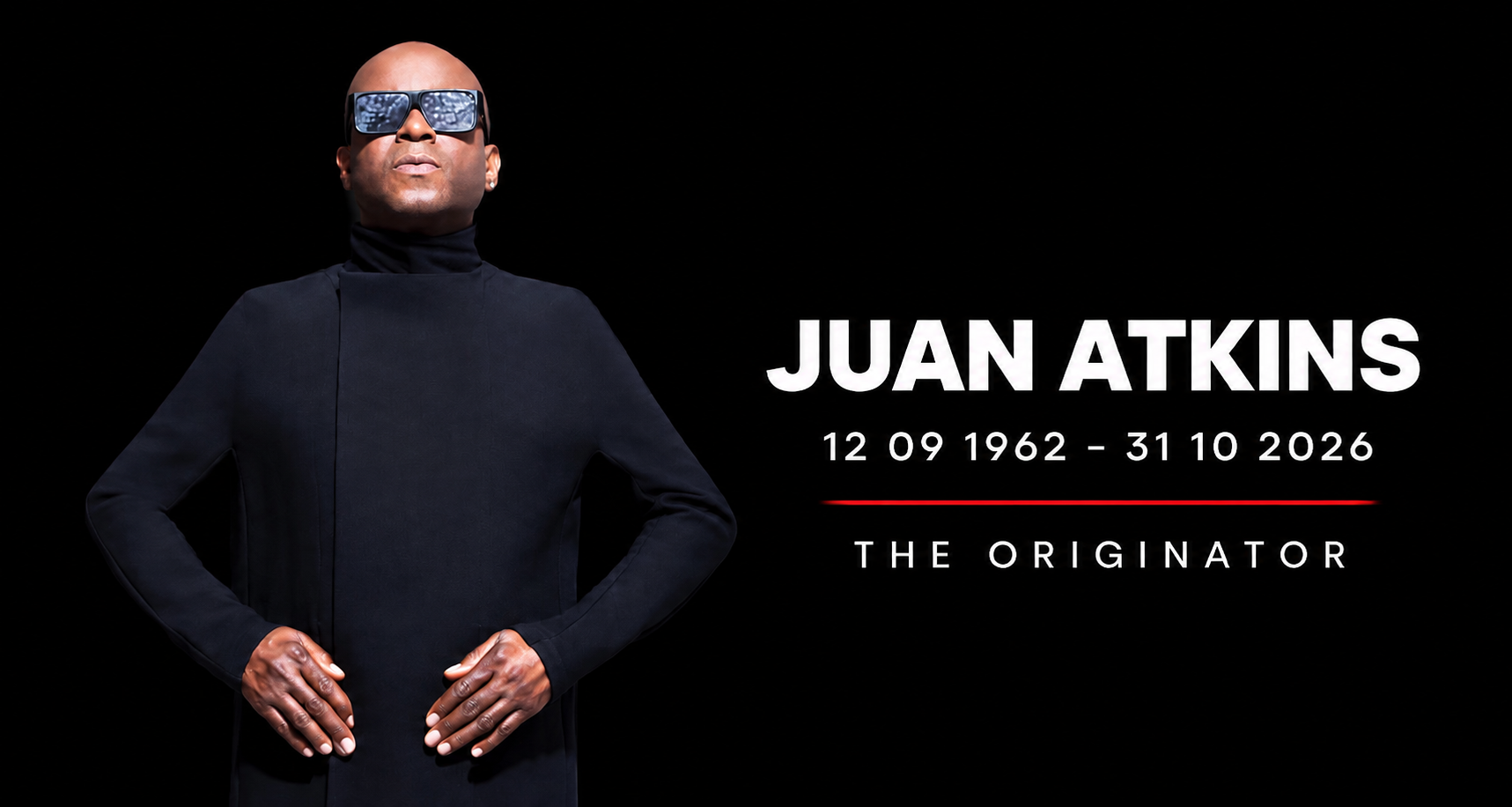
There are artists who leave their mark on music history, and then there are those who help shape an entirely new musical language. Juan Atkins belonged to the latter. Widely known as The Originator and celebrated around the world as the Godfather of Techno, the Detroit-born producer and DJ was one of the most influential figures in the birth and development of electronic music. His death on October 31, 2026, at the age of 64, marks a profound loss for the international electronic music community.
The news was confirmed on November 1 by Greensmith Artists, the agency representing him. Atkins was in Mexico City, where he had been scheduled to perform at YuYu Cine Club. According to information provided by his management to Resident Advisor, he was found unresponsive in his hotel room and later pronounced dead after being taken to hospital. No official cause of death has been announced.
Born in Detroit in 1962 and raised in nearby Belleville, Michigan, Atkins developed an interest in electronic music at a time when synthesizers and drum machines were still opening up possibilities that few artists had begun to explore. He purchased his first synthesizer, a Korg MS-10, at just fifteen years old, beginning a creative journey that would eventually change the direction of dance music. His influences brought together the extraordinary funk of Parliament-Funkadelic, the futuristic electronic structures of Kraftwerk and the pioneering dance productions of Giorgio Moroder, alongside the forward-looking ideas of futurist writer Alvin Toffler. From this combination emerged a distinctive musical vision, built around the meeting of African-American musical heritage, technological experimentation and an imagination that was always looking towards the future.
During his school years, Atkins met Derrick May and Kevin Saunderson. Their shared passion for music, technology and experimentation would eventually bring them together as the legendary Belleville Three, the trio whose pioneering work helped establish Detroit as one of the most important creative centres in electronic music. At the time, none of them could have imagined how far their ideas would travel, or how profoundly they would influence the evolution of club culture around the world.
In 1980, Atkins joined forces with Richard Davis, also known as 3070, to form Cybotron. The project became one of the earliest expressions of Detroit’s emerging electronic sound, combining synthesised arrangements, programmed rhythms and futuristic atmospheres in a way that challenged the conventions of contemporary dance music. After early releases such as “Alleys of Your Mind”, the duo delivered “Clear” in 1983, a track widely regarded as one of the defining proto-techno recordings. Its influence would extend far beyond the original underground scene, reaching hip-hop culture as well: in 2005, Missy Elliott famously sampled the track for her hit “Lose Control”.
Following his departure from Cybotron, Atkins began developing a more personal musical identity under the name Model 500. In 1985, he released “No UFOs”, a landmark production that helped establish the foundations of Detroit techno. That same year, he founded Metroplex Records, an independent label that became a vital platform for his own productions and for the wider underground movement emerging from the city.
Atkins also played an important role in defining the identity of the genre itself. He had long described the music he was creating as techno, and his 1988 release “Techno Music” further helped establish the term internationally. Its inclusion in the influential British compilation “Techno! The New Dance Sound of Detroit” introduced a wider European audience to the sound coming out of the Motor City and helped bring a name to a movement that was already beginning to transform electronic music.
As Detroit techno crossed the Atlantic, it found an enthusiastic audience in the United Kingdom and Germany, helping inspire the emerging rave movement and a new generation of electronic music producers and DJs. The sound that had developed in the studios and underground spaces of Detroit soon became an essential part of the international club scene. Atkins remained at the centre of this evolution, continuing to release music under different aliases, including Model 500 and Infiniti, while establishing himself throughout the 1990s as one of the most prolific and sought-after producers in electronic music.
One of the defining qualities of his work was his ability to absorb new rhythmic influences without losing the melodic sensitivity that made his productions instantly recognisable. He understood how electronic music could evolve while remaining connected to its roots, and this instinct allowed him to move naturally through different musical eras. His influence was equally powerful behind the decks, where he brought his distinctive musical vision to clubs in Detroit, New York, London, Paris and Berlin. Across these cities, audiences recognised an artist whose relationship with the dancefloor was built on curiosity, musical knowledge and a constant desire to discover new sounds.
His work even reached beyond the music industry. In 2000, one of Atkins’ original compositions was selected as the musical soundtrack for the launch of the Ford Focus, in a campaign connected to Detroit Techno. It was an unusual but meaningful recognition of how far the sound born in Detroit had travelled, becoming part of a wider cultural landscape beyond underground clubs and record stores.
Over the following decades, Atkins never stopped exploring new creative directions. He continued developing his projects as Model 500 and Infiniti, returned to Cybotron and collaborated with German producer Moritz von Oswald as part of Borderland. These projects reflected his enduring interest in experimentation and his ability to connect different electronic music traditions. In 2023, he brought Cybotron back to life alongside Laurens von Oswald, demonstrating that the original spirit behind the project remained as relevant as ever.
Following the announcement of his death, Kevin Saunderson paid tribute to his longtime friend and fellow member of the Belleville Three, remembering him as a brother and acknowledging the enormous influence he had on his own musical journey. Their story began when they were young, sharing ideas and discovering new sounds together, long before the world understood the importance of what they were creating.
Today, Juan Atkins leaves behind a legacy that reaches far beyond his discography. His work helped establish the foundations of a global musical culture, influencing generations of producers, DJs and artists who continue to explore the possibilities of electronic sound. From the earliest Cybotron recordings to the productions released under Model 500, his music carried a sense of possibility that has never really disappeared.
The world has lost one of its greatest electronic music pioneers, but the sound he helped create continues to live in clubs, festivals and studios across the globe. Every new generation that discovers Detroit techno becomes part of a story that began with a handful of young musicians, a passion for experimentation and the belief that music could sound completely different.
Juan Atkins imagined a musical future that had not yet arrived. Through his work, he gave that future a sound, and the world has been dancing to it ever since.
Goodbye, Juan.